
Home / Treatments / Lipedema / Process
Body · Process
Lipedema liposuction – the process step by step
The treatment of lipedema is often a journey in several stages. This is how it typically proceeds – from diagnosis to aftercare.
Lipedema is not about correcting the figure, but about treating a disease. That is why it starts with the diagnosis – and ends with careful aftercare. The steps show the typical process.
The process at a glance
- 01Weeks to months beforehandDiagnosis & planning
Diagnosis, previous conservative therapy, planning of regions and stages, clarification of costs.
- 02one day of surgery per stageSurgery
Liposuction under general anesthesia with tumescence, performed gently along the direction of the lymphatic vessels.
- 03Weeks to monthsAftercare
Compression, lymphatic drainage, exercise, check-ups.
What happens during surgery
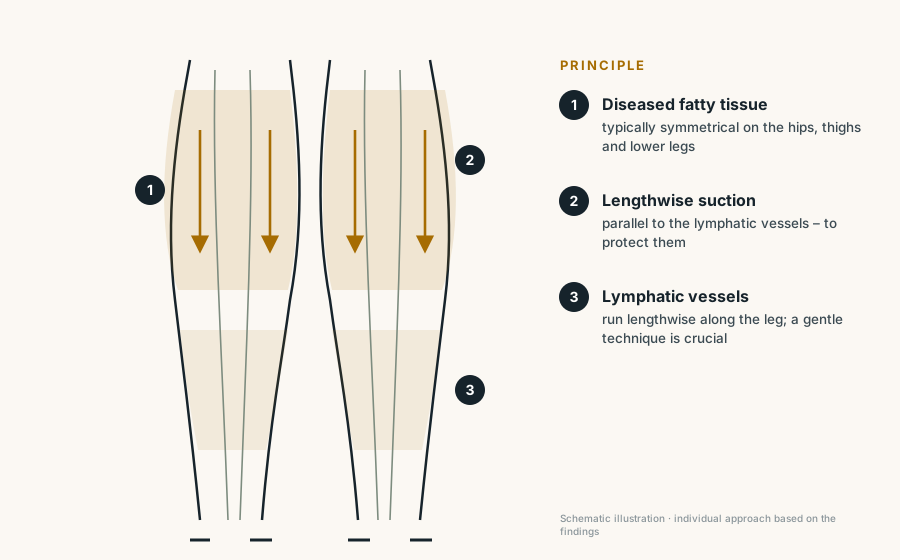
Phase 1: Diagnosis and planning
- Diagnosis Symptoms, distribution of the fatty tissue and medical history are assessed by a doctor.
- Conservative therapy Compression, lymphatic drainage and exercise – they relieve symptoms but do not remove the tissue.
- Stages With pronounced findings, regions (e.g. legs and arms) are often treated in separate sessions.
- Question of costs Clarify before starting whether coverage of costs is possible – you submit the application before treatment.
- Compression garments fitted in advance.
Phase 2: The day of surgery
- Marking The regions to be treated are marked while you are standing.
- Anesthesia and tumescence General anesthesia with tumescent local anesthesia.
- Suction With vibration techniques and thin cannulas – lengthwise, parallel to the lymphatic vessels, to protect them.
- Compression Immediately after the procedure.
- Monitoring With larger volumes, careful monitoring after the procedure is particularly important.
Phase 3: Aftercare
- Day 1–3Swelling and a feeling of tension; compression day and night
- Week 1–2Lymphatic drainage as prescribed; light movement
- Week 3–6Continue compression as instructed; gradually increase activity
- Month 3–6Check-up; planning of the next stage, if intended
- long termCompression can often be reduced depending on the findings; exercise remains important
Contact us immediately in case of fever, severe pain, shortness of breath, a leg severely swollen on one side or redness around an access point.
Your checklist
- Bring documents on your diagnosis and previous therapy
- Clarify coverage of costs before starting
- Have compression garments fitted in advance
- Schedule lymphatic drainage appointments for the time after surgery
Condition, treatment and the question of costs